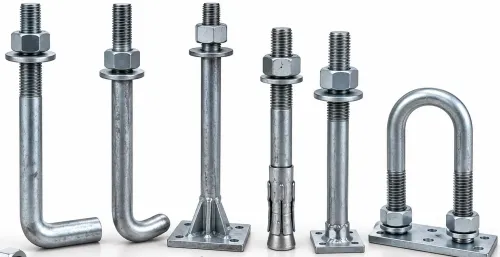
A rod that matches the drawing in diameter can still fail at the thread, connection, coating, or adjustment detail. Before requesting a quotation, you will be able to define the rod’s structural role, measure it correctly, specify its finish, and require records that prove the delivered assembly meets the project specification.
Key takeaways
- Separate bracing rods from sag rods before calculating quantities.
- Specify diameter, steel grade, threads, nuts, washers and turnbuckles together.
- Match galvanising or paint systems to exposure and inspection needs.
- Approve drawings, mill certificates, coating records and packing before dispatch.
Bracing Rods and Sag Rods Do Different Jobs
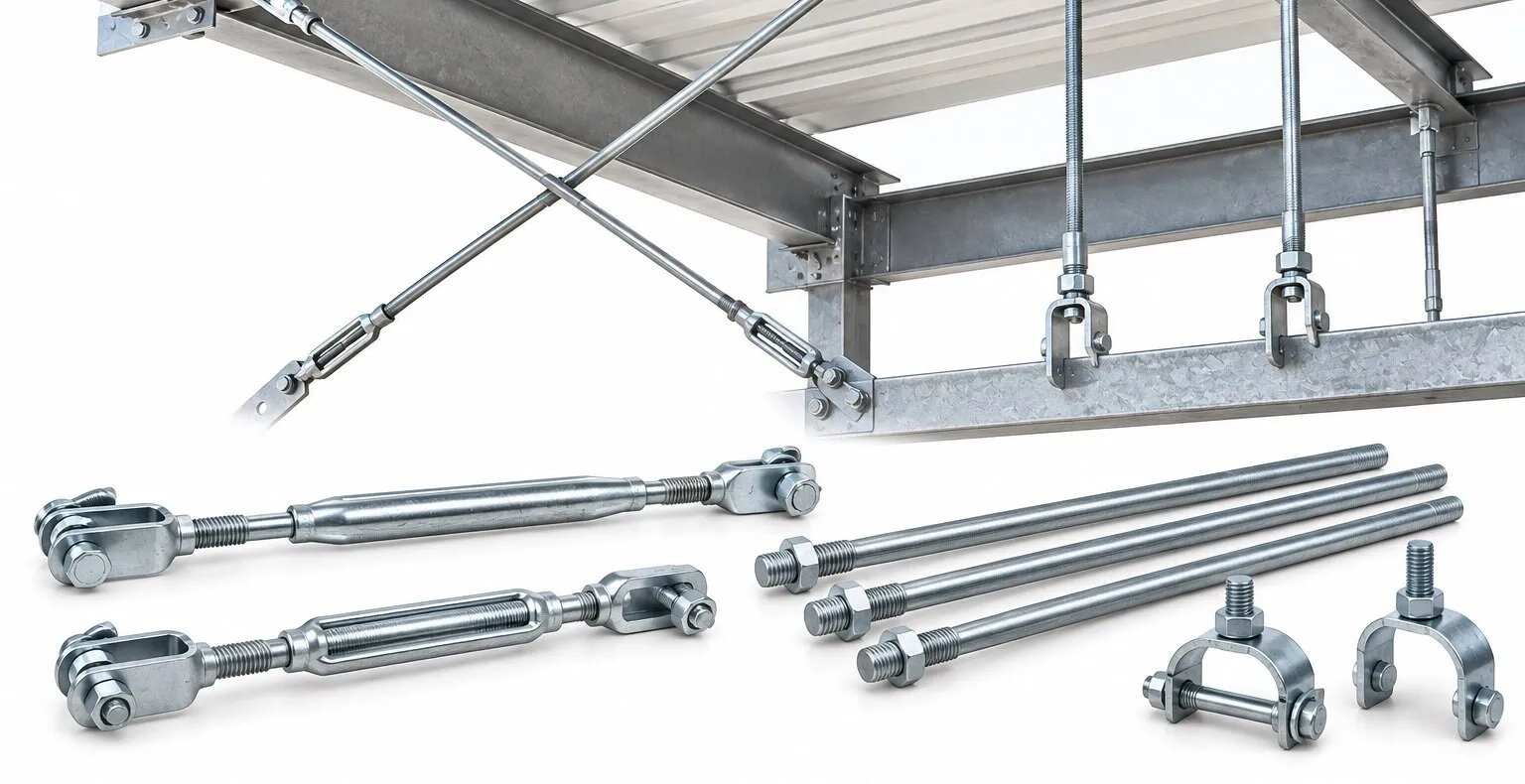
A bracing rod stabilises a roof or wall bay, while a sag rod restrains purlins and keeps their line aligned. They are not interchangeable, even when their diameters look identical.
| Function | Position | Installation |
|---|---|---|
| Bracing rod | Diagonal across a roof or wall bay | Connects framing nodes, cleats or rafters with nuts, washers and a turnbuckle or clevis for tension adjustment |
| Sag rod | Between purlins or along a purlin line | Passes through prepared purlin holes and is secured with nuts and washers as an intermediate restraint |
Bracing rods form a cross-brace or diagonal tension system. Install each end at the specified cleat or framing connection, tighten the adjuster after the frame is aligned, and lock the nuts. Do not credit the rod with compression restraint unless the structural design specifically allows it.
Sag rods support the purlin restraint arrangement rather than replacing the purlins. Loose threads, missing washers or poor alignment can leave a purlin line free to move, so check full thread engagement and the final adjustment after roofing is aligned.
Before ordering, measure the required rod length between connection centres, then allow for end fittings, washers, nuts, turnbuckles and adjustment travel. Record:
- rod diameter, overall length, threaded length, thread pitch and tolerance
- end configuration, bend or hook details, and left- or right-hand thread
- nut and washer quantity, clevis or turnbuckle type, and connection-hole size
- the design load path, not just purlin spacing or a neighbouring rod’s size
For finish requirements in Nagpur, state the exposure and coating system; “GI” or “painted” alone cannot define acceptance.
Build the Bracing Rod Order Specification Before Measuring Quantity
Measure each rod between connection centres, not between the outer faces of purlins or rafters. Add only the adjustment allowance created by the specified turnbuckle, clevis, nuts and washers; otherwise a nominally correct rod can finish too short or leave insufficient thread engagement.
| Reference | State on the order | Why it matters |
|---|---|---|
| Overall length | Centre-to-centre length, tolerance, and adjustment allowance | Prevents site cutting or forced connections |
| Threaded length | Thread length at each end, including any unequal ends | Ensures full nut engagement after washers |
| Thread specification | Thread form, pitch, tolerance, and left- or right-hand requirement | Stops incompatible nuts and turnbuckles |
| End configuration | Plain threaded end, eye, clevis, hook or bent detail; include bend radius and orientation | A correct diameter cannot compensate for the wrong connection |
Your bracing rod order specifications should also identify:
- Rod diameter and steel grade, or the required tensile and yield properties.
- Turnbuckle or clevis type, pin diameter, hole diameter and connection-centre dimensions.
- Nut and washer quantity, size, grade and washer outside diameter.
- Whether both ends need right-hand threads or one end needs a left-hand thread for adjustment.
- Required dimensional tolerances, straightness and thread runout.
- A trial assembly or thread-gauge check before dispatch, especially for galvanized assemblies.
Mark each rod or bundle with its grid line, bay and position. That identification prevents rods of similar length from being swapped during erection.
Use the Load Path to Choose Diameter, Grade and Assembly Details
Diameter and steel grade come after the load path, not before it. Provide the purlin layout, roof dead and imposed loads, wind actions, restraint arrangement, rod inclination, and the designer’s calculation showing whether the rod carries tension only or receives any compression-restraint credit.
A sag rod sized from purlin spacing alone can be too flexible, overloaded, or wrongly connected.
| Design information | State before ordering | Why it changes the order |
|---|---|---|
| Load path | Supported members, load direction, tributary width, and design force | Establishes required tensile capacity and diameter |
| Restraint action | Tension-only use or credited compression restraint | Determines whether slenderness, buckling, or a different member is needed |
| Geometry | Connection centres, rod angle, purlin spacing, and offsets | Changes force, length, thread engagement, and fitting clearance |
| Adjustment | Required pretension, turnbuckle travel, or other adjustment method | Determines threaded length, thread hand, and assembly type |
Specify the complete load-carrying assembly, not just a stronger rod:
- Rod diameter and steel grade or required yield and tensile properties
- Overall length, threaded length, thread form, pitch, tolerance, and end detail
- Nut and washer sizes, clevis or turnbuckle type, and left- and right-hand threads where adjustment requires them
- Connection design for cleats, purlins, rafters, and any splice or tensioner
A high-strength rod still fails as a system if the washer bears on a thin cleat, threads lack engagement, or the turnbuckle runs out of travel. Require sag rod quality requirements to cover traceability, material certificates, dimensional and thread checks, and mechanical results—not merely a supplier statement that the rod meets a standard.
Specify the Finish by Exposure, Coating System and Inspection Method
Request the finish against exposure and service life, not a colour or the words “GI” or “painted.” For bracing rod finish in nagpur, identify whether the rods are inside, sheltered, exposed to monsoon rain, or subject to industrial fumes, then state the coating system and acceptance criteria in the purchase order.
| System | Specify in the order | Inspection focus |
|---|---|---|
| Hot-dip galvanizing | IS 4759, minimum zinc coating mass or thickness, and whether average, local minimum, or both govern | Coating-mass or thickness results, including cut ends, thread transitions, sharp edges, and contact points |
| Paint system | Surface preparation, primer chemistry, number of coats, topcoat, colour reference, and dry-film thickness | Surface cleanliness, intercoat records, dry-film readings, and damaged areas |
| Zinc-rich repair | Approved repair material and repair procedure for transport or fabrication damage | Repaired coverage and adhesion or thickness records required by the project specification |
For sag rod coating requirements in nagpur, keep colour separate from corrosion protection. An approved colour sample must not replace the specified zinc value, paint chemistry, or dry-film thickness.
Add these details before approval:
- State whether threads are cut before galvanizing, how excess zinc is removed, and which compatible nuts are supplied.
- Define treatment of damaged coating at threads, cut ends, bends, and contact points; do not accept appearance alone.
- Require heat or batch traceability, material test certificate, dimensional and thread inspection, coating records, coating results, and packing identification.
- Reject a generic “as per standard” declaration when the supplier has not reported the specified measurements.
Check the Technical Submittal Before Dispatch and Receipt
Reject a vague “GI” or “painted” approval. For a Nagpur project, the purchase order must tie the finish to site exposure, the project specification and the intended maintenance life; there is no universal Nagpur-specific coating rule.
Request this dossier before dispatch:
- Heat or batch number linked to each rod bundle
- Material test certificate stating grade and chemical and mechanical results
- Dimensional report covering diameter, length, threaded length, thread pitch and end details
- Thread inspection record, including gauge results or a trial assembly with the supplied nuts and turnbuckles
- Galvanizing certificate showing coating mass or thickness, with both average and local-minimum acceptance values if specified
- Paint records stating surface preparation, primer, intermediate coat, topcoat, colour, dry-film thickness and curing
- Packing list identifying bundle contents and preserving heat or batch traceability
Compare the submitted evidence with the receiving checks:
| Item | Before dispatch | On receipt |
|---|---|---|
| Galvanized rods | Coating report and compatible nut system | No bare patches, heavy runs or seized threads; test-fit a nut |
| Painted rods | Chemistry, colour reference and dry-film readings | Continuous coating, correct colour and no transport damage |
| All rods | Approved drawing and dimensional report | Measure length, diameter, threads, washers and nuts against it |
Do not force an ordinary nut onto a galvanized thread; it can strip zinc and destroy adjustment. Confirm touch-up limits and whether shop primer must be removed before welding or overcoating. Whether the supplier is RSR Steel Pvt. Ltd. or another fabricator, record these checks against the batch number.
That is a usable bracing rod finish in Nagpur and defensible sag rod quality requirements.
Related product
 | Bracing Rods & Sag Rod Solutions Bracing Rods & Sag Rod Solutions RSR Steel Pvt. Ltd. offers high-strength Bracing Rods and Sag Rods designed to enhance the stability and alignment of steel structures. View product → |
Frequently asked questions
What is the difference between bracing rods and sag rods?
Bracing rods stabilise roof or wall bays by transferring forces through the frame. Sag rods support and align purlins between frames; the two products are not interchangeable.
What information belongs in a bracing rod order specification?
State the rod location, required quantity, diameter, steel grade, threaded length, thread type, nuts, washers, turnbuckles, connection details and finish.
How do you choose the finish for bracing rods and sag rods in Nagpur?
Choose the finish from the exposure, coating system and inspection method. State whether the rods require galvanising or a defined paint system, then specify how coating coverage and thickness will be checked.
What should you check before bracing rods and sag rods are dispatched?
Review approved drawings, dimensions, steel and coating documents, thread and accessory details, identification markings, packing and the inspection release before dispatch and receipt.
Keywords