A roof-mounted turbine is only one part of a factory ventilation system, and its quoted air volume means little without wind speed, pressure, inlet design, and test conditions. By the end, you will have a practical method for assessing site suitability, calculating preliminary airflow, comparing alternatives, and checking a quotation before approving installation.
Key takeaways
- Measure heat sources, contaminants, roof height and operating hours before requesting quotes.
- Reject one-unit-per-area rules; compare airflow, static pressure and tested operating conditions.
- Provide dedicated make-up-air openings so exhaust does not starve the ventilation system.
- Audit roof loads, flashing, corrosion protection, maintenance access and replacement obligations.
Collect the factory data before asking for a quotation
A turbo ventilator suits your Nagpur factory only after you document the heat, air movement and contaminant sources it must handle. For turbo air ventilators for selection requirements in nagpur, collect measured site data rather than accepting a fixed “one unit per area” rule.
1. Measure the floor area, clear internal height and building volume. Record roof type, roof pitch, ridge details and available mounting positions.
2. Record process heat from furnaces, compressors, welding, machinery and sun-exposed roofing. Note occupancy, shifts, operating hours and the indoor temperature you need to control. For a preliminary check, use Q = ρcpV̇ΔT; 1 m³/s removes about 1.2 kW of sensible heat for each 1°C temperature difference.
3. Map every existing opening, including doors, wall louvers, ridge inlets and blocked vents. Measure their approximate free area and identify whether replacement air can sweep occupied zones instead of flowing straight to the roof outlet.
4. List dust, smoke, welding fumes, solvent vapours, oil mist and other contaminants by process and location. A roof ventilator cannot replace local exhaust capture at the emission point.
5. Ask suppliers to state airflow against wind speed and static pressure, starting wind speed, operating wind range, recommended air changes per hour and test conditions. Include the building volume, target ACH and inlet arrangement in your quotation request.
Use IS 3103 and the National Building Code of India as design inputs. Good factory ventilator selection in nagpur begins with this site record, not a catalogue CMM figure.
Compare the specifications behind the capacity claim
Two quoted models are comparable only when their airflow, test conditions, opening size and installation assumptions match. A catalogue claim such as “10,000 m³/h” is incomplete without the wind speed or static pressure at which that output was measured.
| Specification | Compare this | Why it matters |
|---|---|---|
| Airflow curve | m³/h against wind speed and static pressure | Wind-driven output falls in calm air and changes with resistance |
| Throat or base diameter | Clear throat size, not outside turbine diameter | A larger outer shell does not prove a larger exhaust opening |
| Free area | Net aerodynamic opening after mesh, guard, damper and hood | Accessories reduce airflow and add pressure loss |
| Operating range | Starting wind speed and usable wind-speed range | A unit that starts at high wind speed provides little extraction on calm days |
| Construction | Blade count, material, thickness and bearing type | These affect balance, corrosion resistance, noise and service life |
| Installation | Roof-pitch range, weight and fixing method | A unit outside its pitch range can leak or sit poorly |
| Capacity basis | Recommended air changes per hour and stated room volume | ACH is meaningless unless both suppliers use the same building volume |
Treat these as core turbo ventilator buying requirements, not optional catalogue details. Ask for the clear opening and pressure loss for every supplied accessory, plus a performance curve rather than a single CMM figure.
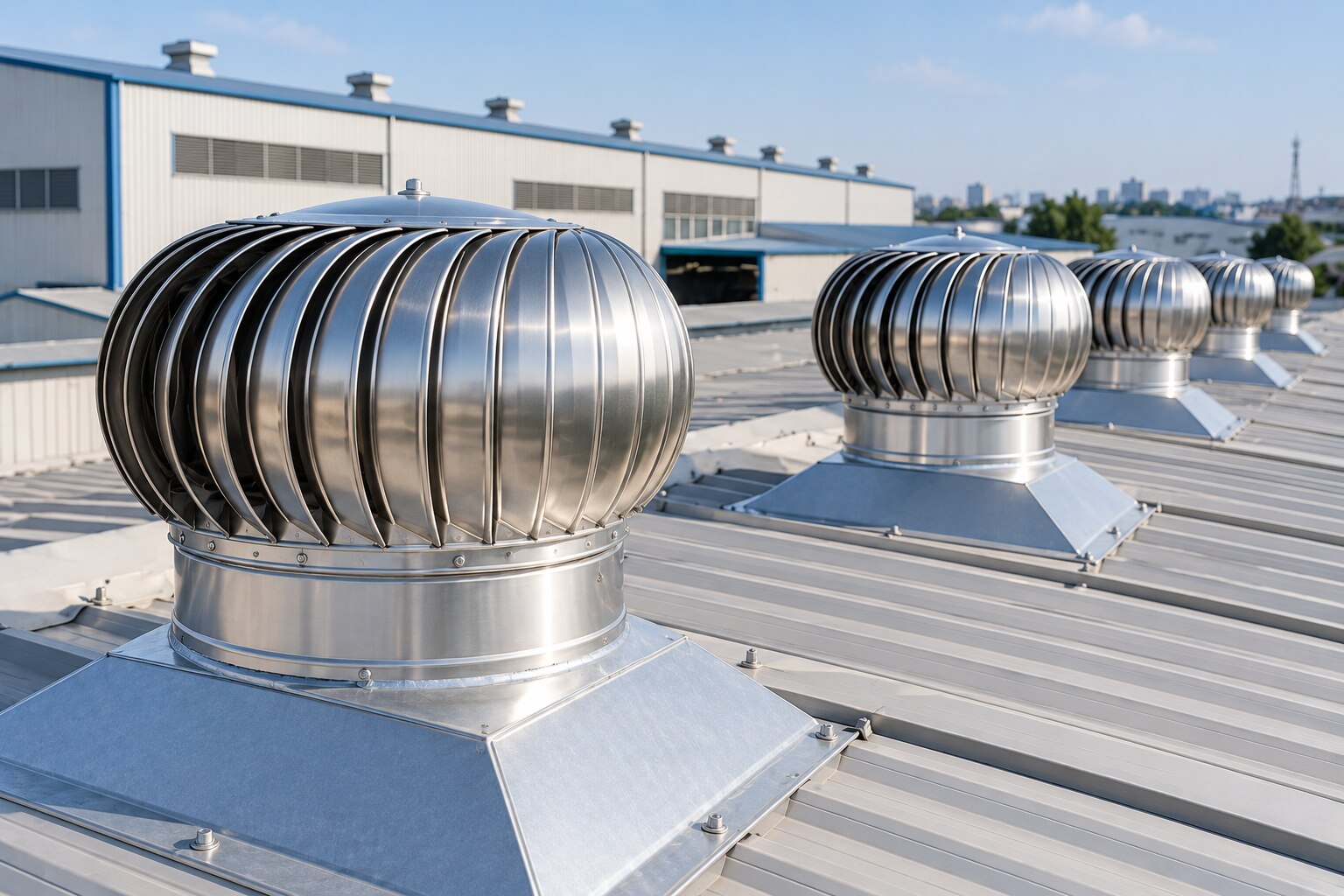
Roof position belongs in the comparison. Turbo ventilator specifications in Nagpur must account for parapets, monitor roofs, solar panels and taller buildings that create wake zones. Compare layouts with separation and distribution over heat-producing areas, not a cluster along one roof edge.
For night work or low-wind periods, compare the passive option against a powered or hybrid extractor against a separately stated minimum airflow.
Calculate exhaust airflow and provide a real make-up-air path
Estimate the required airflow before counting roof units. For sensible heat, use Q = ρcpV̇ΔT. With air density of 1.2 kg/m³ and specific heat of 1.005 kJ/kg·K, 1 m³/s removes about 1.2 kW for each 1°C temperature difference.
A 100 kW heat load with a 10°C allowable rise therefore needs about 8.3 m³/s of exhaust airflow.
- Add solar heat entering the roof and walls to process heat; Nagpur’s pre-monsoon roof temperatures can make the process-only figure too low.
- Check the same airflow against ACH = 3,600 × airflow in m³/s ÷ building volume in m³.
- Divide the required airflow by each ventilator’s tested delivery at the specified wind speed and static pressure, then round up. A catalogue CMM figure without those conditions cannot establish the number of units.
- Treat the result as a heat-removal check, not proof that welding fumes, solvent vapours or dust are controlled.
Exhausted air must have a deliberate replacement path. Provide low-level, distributed wall inlets or opposite-side louvers, sized for the required airflow at their design face velocity, with insect screens and rain protection. Keep the inlets clear of vehicle exhaust and dusty operations; relying on closed doors or random leakage starves the ventilators and reduces extraction.
Ask for an airflow-versus-wind-speed curve in the turbo ventilator specifications in Nagpur, plus inlet free area and pressure data. These are core turbo air ventilators for selection requirements in Nagpur, not optional catalogue details.
Match the ventilation method to heat, contaminants and operating conditions
A turbo ventilator suits a factory that needs passive removal of accumulated heat, odour and stale air from a relatively clean process. It cannot protect workers from welding fumes, solvent vapours or dust released at a machine, because contaminants reach the breathing zone before rising to the roof.
| Option | What it does | When it applies |
|---|---|---|
| Turbo ventilator | Uses wind and buoyancy for roof-level exhaust | Clean, heat-loaded buildings with adequate make-up air and no guaranteed minimum airflow |
| Local exhaust | Captures emissions at the source | Welding, solvent handling, grinding, dust transfer and combustion points |
| Powered extraction | Maintains specified airflow despite calm weather | Night operation, low-wind periods, heat-sensitive production and controlled ventilation |
| Cooling | Lowers occupied-zone temperature rather than removing air alone | High solar or process heat where exhaust cannot reach the required comfort condition |
| Combined system | Pairs source capture with dilution, roof exhaust or cooling | Factories with contaminants plus substantial heat or humidity loads |
For factory ventilator selection in Nagpur, check sensible heat with Q = ρcpV̇ΔT: at 1 m³/s, air removes about 1.2 kW for each 1°C indoor-to-outdoor difference. This does not set contaminant limits or comfort. Include solar and process heat, then specify monsoon rain ingress, flashing, drainage and roof-curb compatibility.
Your turbo ventilator buying requirements should state minimum airflow independently of energy savings, plus make-up-air paths through louvers or controlled doors. Place inlets to sweep occupied areas, not short-circuit directly to outlets, and demand an airflow-versus-wind-speed or static-pressure curve.
Audit the quotation, roof installation and lifecycle obligations
Before purchase, make the quotation contractually measurable. Whether the supplier is RSR Steel Pvt. Ltd or another vendor, require performance data for the actual roof arrangement, not a catalogue CMM number without test conditions.
1. Check the quoted throat diameter separately from the outside turbine diameter. Require net free area, blade count, material thickness, bearing type, roof-pitch range, starting wind speed, operating wind-speed range, and an airflow-versus-wind-speed or static-pressure curve.
2. List every accessory: bird screen, insect mesh, weather hood, damper and safety guard. Ask for each item’s pressure loss and confirm the clear aerodynamic opening. Gross face area is not usable airflow.
3. Attach a roof plan showing unit locations, separation, roof height, parapets, monitor roofs, solar panels and taller neighbouring buildings. Reject a layout that places turbines in wakes or concentrates them at one roof edge. Mark make-up-air openings so air sweeps occupied zones instead of short-circuiting to outlets.
4. Specify the minimum airflow required during calm nights and low-wind periods. If the passive layout cannot guarantee it, price powered or hybrid extractors separately.
5. Make commissioning records part of the handover: installed unit numbers, measured dimensions, roof sealing, rotation, obstructions, inlet paths and measured airflow under recorded wind conditions.
6. Put lifecycle duties in writing: corrosion inspection, bearing replacement, cleaning of screens, spare-part availability, warranty exclusions and access equipment. These turbo ventilator buying requirements are essential to the turbo ventilator specifications in Nagpur.
Related product
 | Turbo Air Ventilators RSR Steel Pvt. Ltd. supplies high-performance Turbo Air Ventilators designed to ensure effective natural ventilation in industrial and commercial... View product → |
Frequently asked questions
What factory data should you collect before requesting a turbo ventilator quotation?
Record floor area, roof height, indoor and outdoor temperatures, heat-producing equipment, contaminant sources, operating hours, existing openings and the required indoor conditions.
How should you compare turbo ventilator capacity claims?
Compare rated airflow at stated test conditions, rotational speed, throat diameter, free area, pressure performance, weather protection and the conditions behind the quoted capacity.
Why does a factory need a make-up-air path with roof exhaust ventilators?
Exhausted air must be replaced through planned doors, louvers or wall openings. Without a real inlet path, airflow falls and the building can draw dust through unwanted gaps.
When is a turbo ventilator the wrong ventilation method?
Use another or additional system when you need controlled airflow, filtration, contaminant capture at source, cooling, mechanical extraction or reliable operation during still weather.
What should you audit in a turbo ventilator quotation and roof installation?
Check the number and location of units, airflow basis, roof penetrations, curb and flashing details, structural loads, corrosion protection, maintenance access, warranties and replacement responsibilities.
Keywords